When startups prepare for funding or strategic investment, most attention goes to revenue growth, user acquisition, and valuation multiples.
However, one critical financial area that often determines whether a deal moves forward smoothly — or stalls — is Debtors Reconciliation, especially for e-commerce and quick-commerce driven businesses.
In our experience working with startups, this is where strong growth stories either gain credibility — or lose investor confidence.
The Reality Behind Marketplace Sales
On paper, sales numbers from platforms like
Amazon,
Flipkart,
Blinkit, and
Swiggy Instamart
may look impressive.
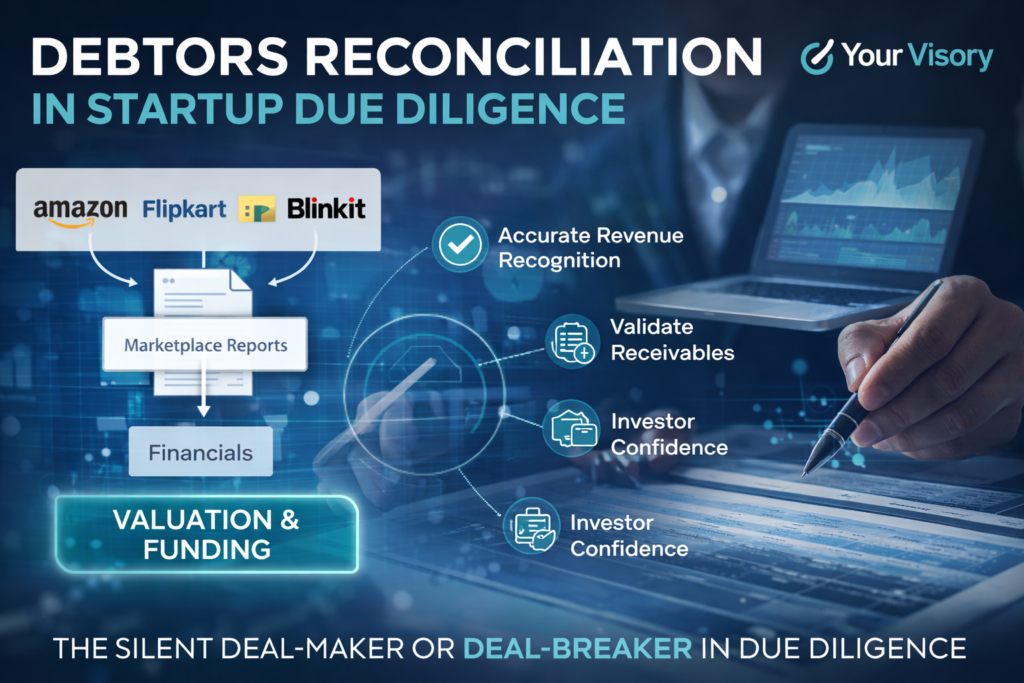
But marketplace revenue is rarely equal to cash received.
Between order placement and final settlement, multiple adjustments take place:
-
Returns & cancellations
-
Platform commissions
-
Advertising charges
-
Discounts & promotional support
-
Penalties & claim adjustments
-
TCS deductions
-
Settlement timing differences
Without structured reconciliation, the books may reflect revenue that does not match actual receivables.
And during due diligence — this gap becomes highly visible.
Why Debtors Reconciliation is Critical During Due Diligence
1️⃣ Accurate Revenue Recognition
Investors assess whether revenue recorded in financial statements aligns with marketplace settlement reports. Any mismatch raises red flags.
2️⃣ Validation of Actual Receivables
Reported sales ≠ Real receivables.
Reconciliation ensures that outstanding debtors are genuine and recoverable.
3️⃣ Identification of Leakage
Untracked deductions, penalties, or claim adjustments directly impact margins and cash flow.
4️⃣ Investor Confidence
Clean reconciled data signals financial discipline, internal control, and operational maturity.
5️⃣ Prevention of Deal Delays
Unreconciled debtors often lead to additional diligence rounds, revised valuations, or funding delays.
The Common Challenge We Observe
Many fast-growing startups focus on scaling operations — which is natural.
However:
-
Marketplace reports are downloaded but not deeply reconciled
-
Settlement files are complex and platform-specific
-
Accounting entries are passed in bulk
-
Adjustments accumulate month after month
As volumes increase across multiple platforms, mismatches compound.
During funding rounds, auditors and investors dig deeper — and suddenly, historical reconciliation gaps become critical issues.
How We Add Value as Auditors & Consultants
At Your Visory, we assist startups with structured, end-to-end debtors reconciliation across all marketplaces and quick-commerce platforms.
Our approach includes:
✔ Mapping marketplace reports with accounting entries
✔ Reconciling gross sales vs net settlements
✔ Identifying unadjusted returns, penalties & deductions
✔ Validating receivable balances
✔ Preparing due-diligence-ready reconciliation summaries
✔ Strengthening internal controls & reporting processes
The result:
-
Clean and reliable financial statements
-
Improved cash flow visibility
-
Reduced financial risk
-
Faster due diligence closures
-
Stronger investor confidence
Strong Growth Deserves Strong Financial Clarity
In today’s funding environment, investors prioritize governance as much as growth.
A startup with ₹10 crore revenue but weak reconciliation processes appears riskier than one with ₹7 crore revenue and strong financial discipline.
If your startup is preparing for:
-
A funding round
-
Statutory audit
-
Internal audit
-
Due diligence review
-
Investor reporting
Now is the right time to strengthen the basics.