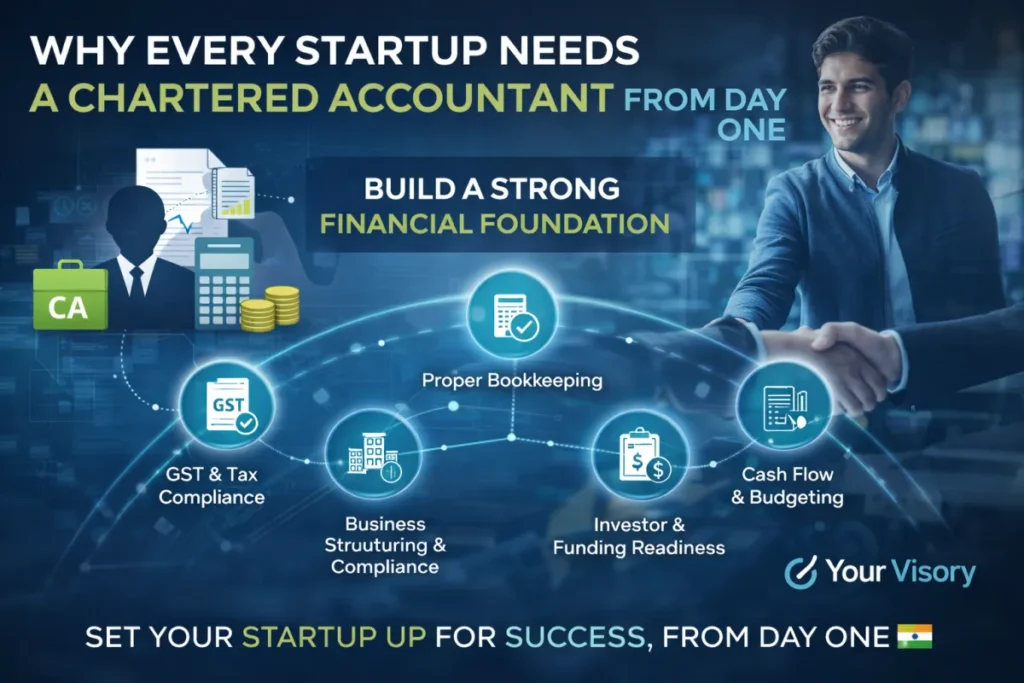
Starting a business is an exciting journey, filled with big dreams, bold decisions, and countless opportunities. But behind every successful startup lies a solid financial foundation—and this is where the role of a Chartered Accountant (CA) becomes crucial. Many entrepreneurs, in the early stages, often underestimate the importance of professional financial guidance, thinking that accounting is something they can handle later. However, the truth is that having a CA from the very beginning can make the difference between a thriving startup and one that struggles to survive.
When a startup is first registered, one of the most important decisions to make is the choice of business structure. Should it be a sole proprietorship, partnership, LLP, or private limited company? Each structure has its own tax implications, compliance requirements, and funding opportunities. A Chartered Accountant helps founders evaluate these options and choose the right structure that aligns with long-term goals. Making the wrong choice at this stage can result in heavy tax burdens, compliance complications, and challenges in raising investment later.
Startups often face the dual challenge of limited resources and unlimited tasks. Founders are usually focused on product development, market reach, and customer acquisition. Financial management often takes a backseat, leading to cash flow problems, missed compliance deadlines, and poor record-keeping. A CA ensures that these aspects are taken care of efficiently—whether it is maintaining accurate books of accounts, filing GST returns, or preparing for audits. With this support, entrepreneurs can focus on scaling the business while staying stress-free about regulatory issues.
Another critical aspect is fundraising. Startups looking to attract angel investors, venture capitalists, or bank loans need to present clear, transparent, and compliant financial statements. A Chartered Accountant not only helps prepare these documents but also ensures that valuations are accurate, projections are realistic, and due diligence processes are smooth. This increases investor confidence and improves the chances of securing funding.
Tax planning is another area where startups benefit significantly. Many government schemes and tax incentives are available for emerging businesses, especially those registered under Startup India or recognized as MSMEs. A CA helps identify these benefits and ensures startups make full use of them, thereby reducing costs and improving profitability. They also assist in implementing internal controls that prevent financial leakages and fraud—a common risk when businesses expand rapidly without proper systems.
Beyond compliance and tax savings, CAs act as strategic advisors. They provide insights on cost management, budgeting, risk assessment, and long-term financial planning. Their expertise helps startups avoid common pitfalls, optimize resources, and grow sustainably. They essentially act as financial partners, guiding entrepreneurs at every step, from idea validation to expansion and even exit strategies.
This blog will dive deeper into the reasons why startups should onboard a Chartered Accountant right from the beginning. It will highlight real-world challenges faced by new businesses, showcase how financial expertise can turn risks into opportunities, and demonstrate how professional guidance helps transform an innovative idea into a scalable, profitable venture.